The core
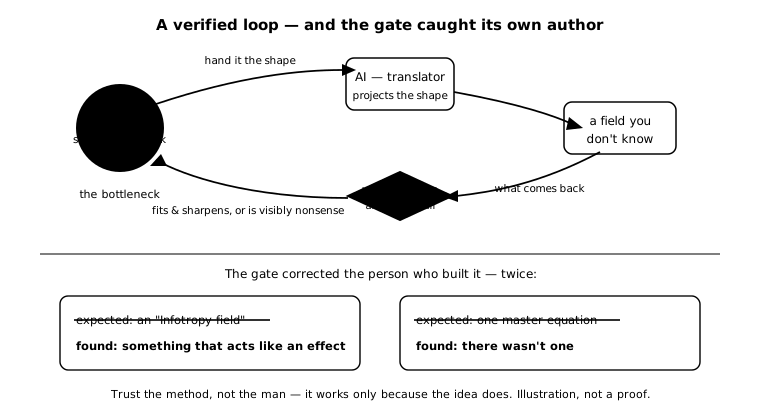
I didn't find all of this at once, and I didn't find it alone. Here's how it actually grew, because the method matters more than any single claim in it.
I use AI the way you'd use a translator. I hand it the shape of an idea and ask it to carry that shape into a field I don't know well — biology, markets, whatever it is. If the idea is real, what comes back fits and sharpens. If it's nonsense, what comes back is nonsense, and you can see that too. Nothing mystical about it. The machine isn't the authority; it only works because the underlying idea works. Which means the weak link in the loop is me — so you build the checking in. Results, tests, the parts that are allowed to fail.
And I half-expected a single clean master equation at the bottom of everything — one Bach chord that explains the music. There wasn't one. Honestly, that was a relief: a master equation would have been too tidy, and far too easy to fool yourself with.
So here's the one thing to carry out of this: you don't have to take any of it on my word. The tools are yours. Bring them to something you already understand and watch whether they land on ground you can check for yourself.
Try it yourself
Here is one. Paste it into any model, then hand it a domain you actually know. The point is to watch whether the shape lands on ground you can already check.
"I want to use a structural lens called funnel / bottleneck / fan-out. The funnel is many upstream pressures narrowing toward one point. The bottleneck is the one surviving form all that pressure produced. The fan-out is what radiates downstream from that form. Take [a domain you know well] and walk me through one clear example: what is funneling in, what is the bottleneck, what is fanning out? Then flip it: look at the same bottleneck from the upstream side, then from the downstream side, and tell me what changes."
You are the evaluator the whole time. The framework is a set of tools. You bring them to a domain you already know.
That's the core, in the shape I first found it in.
There's a sharper version of the same idea — cut down until it does its work in about three lines. If you want it, it's right through here.