The core
More than you would guess.
Clausius, measuring the heat a steam engine throws away. He measured the record side first, under a different name — putting a number on what a channel can carry, and founding information theory in the process. One of the closest native fits., counting what a telegraph wire can carry. A thing’s information as the length of the shortest program that rebuilds it — squeeze a description down to the most compact form that still restores the whole. That is the same move as Shannon’s, just with a heavier mechanism; the link between the two is a theorem, not a coincidence. The record-and-cost half it leaves out is carried by logical depth — not how short the program is, but how much work it takes to run. A genuine fit through the compression lens, not a divergence., asking how short a description can get before it breaks. A strand of DNA holding the instructions for a body. An archive holding the memory of a city. A thermostat. A photograph. A fossil.
Every one of these has its own exact definition of "information" or "entropy." They were built in different fields, by people who mostly weren't talking to each other, and they do not share a mechanism — a steam engine and a strand of DNA have nothing in common at the level of parts. So the honest question isn't "what's the master equation." There isn't one, and there shouldn't be. The question is: read each of these from the record side — ask not what got spent but what survived the spending — and does the same thing show up every time?
Take the oldest one and actually do it. Clausius, in the 1800s, defined entropy as heat going to waste — the warmth a steam engine dumps and can never use again. Read the normal way, that's a tally of loss, an accountant counting what leaked out. Now read the very same event from the record side. Quench a hot iron bar in oil: yes, the heat disperses into the oil and is gone — but the bar that comes out is changed. Its grain, its hardness, the stresses locked into it are a durable record of exactly that cooling, readable years later by anyone who knows how to look. The loss and the record are one event, written down twice. Clausius kept only the first column. What Infotropy adds is the second one: wherever heat is spent, ask what survived — because something usually did.
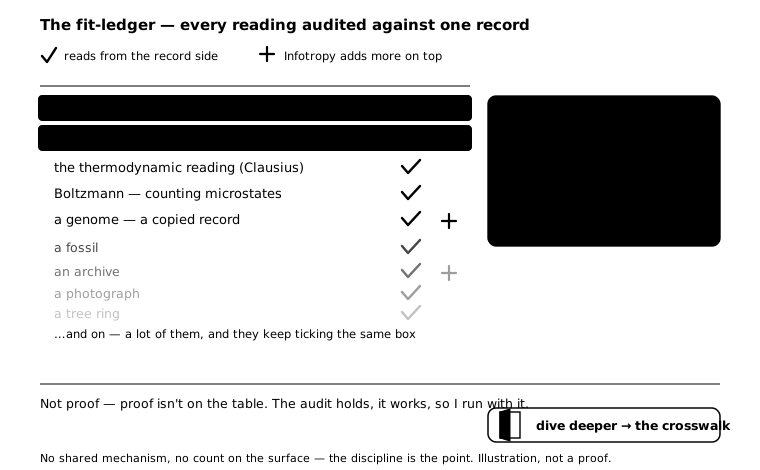
So that's the reading discipline: take any of these measures and ask what it looks like from the record side, what survives and what that survivor goes on to build. And here is the receipt — the actual work, not a promise of it. We ran that move down the whole roll-call, field after field, definition after definition. A contradiction would have looked like a definition whose costly, one-way event carried a cost reading but no record side at all — and every one we ran it against admitted the record-side reading instead. In a real handful of places, the field had already gotten there on its own and was doing exactly this under its own name.
And not all of it stays this abstract. The sharpest version of the record idea is concrete enough to check, and it's waiting near the end of this walk: you can rebuild a crystal from the conditions that made it, but you cannot rebuild a genome the same way — the living record carries something its surroundings simply don't. I'll earn that properly when we get there; for now just mark it, so you know these readings point at something with hard edges, not only at a nicer way to talk.
Now the honest status of all of it. Fitting this many definitions isn't proof — and proof, here, isn't really even on the table; there's no single experiment that settles whether two fields are reading one thing or two. So I won't call it proven. I call it a working interpretation: strongly supported, shown with receipts like the ones above, and run with because it keeps working. That's the claim, said once, plainly. Everything after this I'll say with confidence — and that's where the confidence comes from.
Try it yourself
Pick the field you know best — physics, code, biology, music, whatever it is. It has its own private definition of "information" or "entropy." Ask it the record-side question: what survives the spending, and what does that survivor go on to build? Watch your own field turn into one local reading of the same thing.
A century of people looked at exactly this and called it a coincidence. Were they wrong?