The core
Think about music for a second. Not a particular song — music itself.
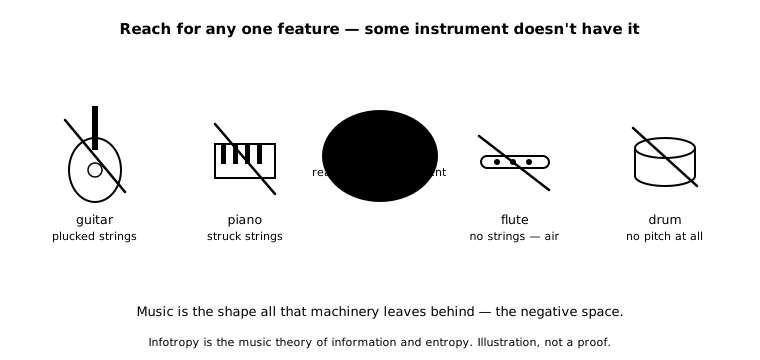
But what is it, exactly? A guitar makes it with vibrating strings. A piano has strings too, but struck instead of plucked. A flute has no strings at all, just a moving column of air. A drum has no pitch worth the name. Reach for any single physical feature and some instrument doesn't have it. There is nothing all of them share that you can put a finger on and say: there, that's the music.
And yet music is completely real. People study it for a lifetime. It has rules, structure, a whole rigorous theory — a theory of something you cannot touch, cannot locate in the strings or the air or your own eardrum.
Music is the shape all that machinery leaves behind. Not any piece of the machinery. The Something completely real and fully describable that lives in no single part of the machinery — the shape the parts leave behind, the way music isn't in any one instrument. You can't point to it, but you can study it rigorously..
Now do the same thing one field over. The physics born of the steam-engine era — Carnot, then Clausius, then Kelvin — where the second law and the very first entropy were forged. Entropy's home field. measures entropy in heat and temperature. Shannon's field, opened in one paper that also coined the bit — the first hard number on the record side. measures it in bits down a wire. Boltzmann's road in: entropy as the log of how many micro-arrangements a bulk state hides — the bridge that turned heat-entropy into counting, the move the rock-to-sand page leans on. counts microstates; a biologist reads it in the order of a gene; a cryptographer measures it as what an adversary can't guess. Reach for the one mechanism all of them share — the single piece of machinery that makes them all "entropy" — and you get the same defeat the instruments just gave you. There isn't one. A steam engine and a strand of DNA have nothing in common at the level of parts. And still they keep measuring something that behaves like one thing.
Infotropy is the music theory of that. Every field that measures information or entropy is one more instrument. The thing they are all sounding — the shape standing in the gap between them — is what this is about. Not a theory of everything. Closer to a theory of nothing — and by nothing I mean the negative space, the shape every instrument is sounding that none of them is made of. The part you can never quite put your finger on.
Sit with that for a second, because it's the strangest move in the whole idea and the rest leans on it: a thing that is completely real, studied for lifetimes, and located nowhere in particular.
Which raises a fair question. How many instruments are there?