The core
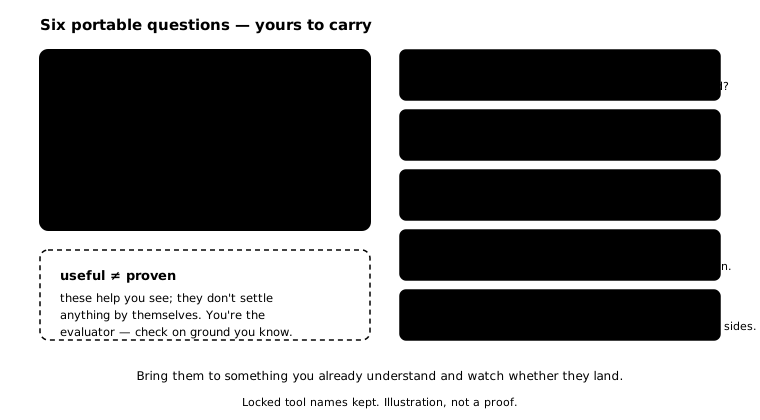
You don't have to take any of this on faith, and you don't have to take it from me. The whole thing comes apart into a few questions you can carry into something you already know better than I do, and check for yourself.
Here's the one I live with. Record Pressure asks how deep a record something leaves, and how hard that record then leans on whatever comes next. I'll make it small and embarrassing: I bought a watch — a Garmin — and started wearing it. It does nothing but keep a record. Steps, sleep, heart rate, sitting there on my wrist. But because the record exists and I can see it, I started seeing myself — and I've quietly trended healthier ever since. Nobody made me. The record just sat there, visible, and pushed. That's record pressure. A visible record exerts a steady downstream force just by existing. Once you feel it on your own wrist you start seeing it everywhere — a credit score, a public scoreboard, a diagnosis written in a chart.
The other five ride alongside it, each one question you can put to any claim, including one you already believe:
- Bottleneck Map — where does the flow narrow, who controls each narrowing, and what gets selected there? (A hiring funnel: résumé screen, phone screen, interview — each a gate, each owned by someone.)
- Patch Count — is the thing holding itself up, or is something propping it up? Count the patches. (Software that's all fixes-on-top-of-fixes; a rule that needs ten exceptions to work.)
- Residual Structure Test — strip every patch away. Is there anything specific left that only this thing predicts? (If nothing's left, the patches were the building.)
- The project's first tool: rotate a thing around its bottleneck until its hidden face swings into view — the move behind the rock-to-sand and the cardboard-dragon demos. You already run it whenever you stop to see a situation from someone else’s side. — turn it around. Look from upstream, not just downstream. (The argument seen from the other person's side.)
- The tell that a flip found something real: turn a true structure and it gains a face and gets more solid; turn a projection and it falls apart — like a cardboard dragon's stare, gone the moment you step behind it. — how much did it change when you turned it? Real structure looks like itself from both sides; a projection dissolves. (The cardboard dragon, seen from behind.)
These are the ones that have fallen out so far — portable, yours, and not a closed set; more may turn up. And the honest caveat that keeps them honest: the watch never proved a thing about my health — it just made the record visible, and I did the rest. These tools are the same. A tool that's useful isn't the same as a claim that's proven. They help you see. They don't settle anything by themselves — you do, on ground you can already check.
Try it yourself
Take a belief you already hold — something you're fairly sure about — and run it through the six, one at a time:
- Bottleneck Map — where does the flow narrow, and who controls each narrowing?
- Record Pressure — how deep a record does it leave, and how hard does that record lean on what comes next?
- Patch Count — is it holding itself up, or is something propping it up?
- Residual Structure Test — strip every patch. Is anything specific left that only this predicts?
- The Flip — turn it around; look from upstream, not just downstream.
- Brittleness Under Flip — how much did it change when you turned it?
You're the evaluator. Run it on home ground you already know better than I do.
That's the whole point, actually. You have it now.