The core
It starts with physics.
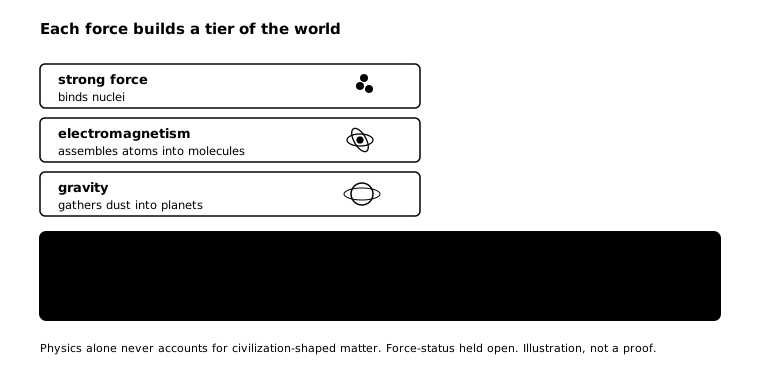
Physics keeps a short list of forces, and each one builds a tier of the world. The One of the handful of fundamental forces — the strongest, shortest-range one, binding the cores of atoms. It builds nuclei; it has nothing to say about why a heap of stone became a pyramid. That's the record's job, not a force's. binds nuclei. Electromagnetism assembles atoms into molecules. Gravity gathers dust into planets. Widen the lens all the way out and that same short list built essentially everything in the universe that nobody made — every star, every ocean, every stone on the beach. Run the list against a heap of cut stones and you can explain almost all of it — why they have mass, why they stack, why they hold, why they fall.
What the list never explains is why one particular heap of stones became a pyramid. And there, in that one gap, is the intuition this whole thing grew out of. If the forces already built everything nobody made, then the single thing that separates all of it from the made world — the pyramid, the cathedral, the page in front of you — is information. That's the line between the natural and the man-made, or close to it. Information behaves like the force that drew that line; whether it is one, in the strict sense, is a question I'm keeping honestly open from the start.
For that you need the other thing entirely: a plan, a measured base, coordinated labor, a calendar, assigned roles, memory carried across generations of workers who never saw it finished. Stay on just one piece of that for a second. The plan outlived the planners. The man who set the first stone was dust before the capstone went on; the crew that finished it never met the crew that started. What carried the shape across all those years wasn't anything on the physics list — it was a record, held in drawings and habits and trained hands, pressing on each new crew the same way, the same shape, for decade after decade until the thing stood. Watch that happen and you've watched information do work on stone. The pyramid is matter disciplined by information across time. Information built it — not by overruling physics, but because physics alone never accounts for civilization-shaped matter.
And one more, set alongside the rest: the strong force makes nuclei, electromagnetism makes molecules, gravity makes planets — those forces made everything else in the universe, and information made the pyramids. It does the kind of work a force does — and as I said up top, whether it is one is the part I'm leaving open; the behavior is what's solid right now, and the behavior is enough to go on.
Try it yourself
Take something people made — a cathedral, an institution, a song. Run it past the four forces: which one explains its shape? None of them do. Something else held that shape across time.
And if something can press on stone for a thousand years — behave that much like a force — it's worth asking where a thing like that even lives. Because it isn't sitting in any one place you could point to.